Saturday, May 15, 2021

Powder Magazine Museum

345 North Road W.
Jefferson Barracks Park
St. Louis 63125
314-615-8800

Admission is free.  Lot with free parking.

https://stlouiscountymo.gov/st-louis-county-departments/parks/places/jefferson-barracks-park/  

Opened in the 1950's

The building that houses the museum was built in 1857 to be used to store rifles, cannons, gun powder and prepared ammunition for those soldiers stationed at Jefferson Barracks. The Barracks were established in 1826 near St. Louis city and on the Mississippi River making it a very important military post in America's history as the nation's territory expanded west. The base is the oldest operating U.S. military installation west of the Mississippi River. 

This building is made of limestone with 4-ft. thick walls and wooden floors.  The arched ceiling and floors were designed so that if the gunpowder exploded, the path of least resistance would be taken and the explosion would go through the floors. The arches above would fall along with sand, etc. and the fire would be smothered. The roof and and walls would remain intact and the building would be still useable.  

Today when you enter you see these same original wooden floors and ceiling arches. There are also many beautiful wooden cases housing an exhibit on the history of the  military post.  Unfortunately the glass in the cases makes it very difficult to take decent photographs of the items on display because of the extensive glare.
Before walking through the museum, one can view a 4-minute film to get a synopsis of the history of Jefferson Barracks. 
The first item on display is from the time of the establishment of the fort. 
This early sign starts you on the story of Jefferson Barracks.
The first war highlighted is the Blackhawk War which took place in 1832 in Illinois. 

These items below are from the Seminole War that took place in Florida in 1837. Future President Colonel Zachary Taylor led the Jefferson Barracks troops 1200 miles to this bloodiest of Indian wars. The coat is a reproduction of a Missouri volunteer frock coat and the hat was actually worn by a Missouri soldier who died in this war. 
Exhibited below from that war are: a M1816 North Pistol, a musket (1784), a powder flask (1830) and an Infantry Tactics Manual (ca 1837). 
The Mexican-American War took place from 1846-1848. The uniform on display was worn by a Mexican soldier. 
The American Calvary was first organized at Jefferson Barracks and included Jefferson Davis and Nathan Boone.  They were called the Dragoons and this is a reproduction of their undress uniform, ca 1840. The sabers are also from 1840. 
When Jefferson Barracks went from being merely a training station to one that supplied everything that went west during our time of westward expansion, the ordnance workers became very important. Below is a uniform of an Ordnance Corps officer in the late 1840's.  There were also civilians workers on base with as many as 500 during the Mexican-American War. 
Some of the medical items from the Civil War on display including a bone saw and an amputation saw. Also the U.S. Surgeon's army sword. 
The Buffalo soldiers were organized in 1866 in six units, one of which was at Jefferson Barracks. The greatcoat is from 1880 and the cap from ca. 1895. 
The cavalry played an important role in the Mexican-American War, the Indian wars, and the Civil War. This saddle is from 1859, while the halter, strap, cinch and blanket are all from 1900.
Some of the cavalry supplies. 
More cavalry displays. 
The uniform of an Infantry Commissary Sergeant: the uniform, dress helmet and saber belt are from 1883-1884 and the saber is from 1840. 
This 1880 hat belonged to Colonel John A. Kress who was the second longest serving commandant at Jefferson Barracks. 
Gauntlets, Epaulets, pistols, and ribbons from near turn-of-the century. 
This display includes U.S. military headgear during a 100-year span. Below are 4 of the 13 hats displayed. 
Items from the Spanish American War (1898) include the Memorial Plaque, canteens, Army Hospital Corps uniform, drill regulations manual, and gauntlet. 
From the Spanish American War and the Philippines Insurrection (1899) there is a pocket Bible, handbook, ribbon, medals, and a bag.
More late-1800 artifacts from the Spanish American War and the war in the Philippines.
From the Mexican Border and the First World War we have a Campaign hat and shirt, a Colt Browning machine gun and the ammunition box as well as patriotic posters designed to create support for the war effort. 
On display is a khaki canvas first aid pouch, 1904, and a khaki canvas Webb belt, 1903 
A World War I German machine gun. 
A World War I gas mask and a medics bag made out of two ration bags. 
An ammunition limber from 1917
Belongings of a World War I soldier
A memorial for fallen World War I soldiers.  This one of sheet metal was created in St. Louis in the early 1920's and called "Our Brave Boys."
This is a bathing suit, ca. 1930, from after World War I from a Civilian Military Training Camp.
The uniform of an army air force recruit during World War II.
Medical supplies from World War II including first aid dressing and case, urinal, field medical kit, blanket, and cup and saucer set. 
An anesthesia machine from World War II. 
Also a dental drill and tools and a foot-powered dental drill. 
World War II weapons.

Remnants of civilian lives during World War II: gas mask!
Beginning in 1944, Jefferson Barracks began housing German and Italian POWS. These two items are part of that display: 1944 handcuff and key and 1944 peach stone carvings done by POW. 

Belongings of a female soldier during World War II: uniform jacket, haversack, and olive drab utility bag. 
Examples of recreation during World War II: softball, baseball, and football. 
The museum has this display on "A Look across Time: Music in the Army." The bugles are from World War I and World War II.  The drum is from the Civil War. 

Under all of the arches there are drawings or informational posters.  These are just two examples. 

Before visiting the museum we ate lunch on the grass outside the museum.
Our view included the Mississippi River and the memorial to the World War II Battle of the Bulge. 
Our lunch came from The Art of Entertaining  which offers gourmet carryout and catering. It is located in Webster Groves.

Picking up all six lunches! 
There is a reason that they have been awarded Best Carry-Out Lunch! We enjoyed our Gourmet Sak Sandwich...
and Gourmet Salad Box Lunch. 

Comments:  This museum is a hidden gem when it comes to military history.  It only covers the history of Jefferson Barracks but JB has been around since 1826 so the museum really covers a vast majority of American military history. My guess is that most people today have little idea how important this military post has been in its role in the military. 

The museum was well-organized and there were posters explaining everything.  I found the displays sometimes confusing because nothing was marked within the cases. One has to figure out what-is-what from the list posted to the side.

The museum is only open W-Sat. and is monitored by a volunteer. When we went on a Wednesday afternoon we were the only ones there. 

As always with Art of Enteretaining, the food was excellent and reasonable.  


Friday, May 14, 2021

Old Ordnance Room Museum

345 North Road
Jefferson Barracks Park
St. Louis   63125
314-615-5000

Free admission. Free parking in parking lot. 

https://stlouiscountymo.gov/st-louis-county-departments/parks/places/jefferson-barracks-park/

Opened in maybe 1950's. 
The Old Ordnance Room was built in 1851 and houses temporary exhibits on military themes. 
Like the Powder Museum, the building was built with thick limestone walls, wooden floors, and an arched ceiling for safety reasons in case there was an explosion. It also has glassed cases that cause reflection when photographing! 
This museum has rotating exhibits.  The current exhibit, Story of Missourians at War,  is on display for ten months. A walk through the museum gives you a chronological view of the role Missourians have played in the military for over 200 years.  

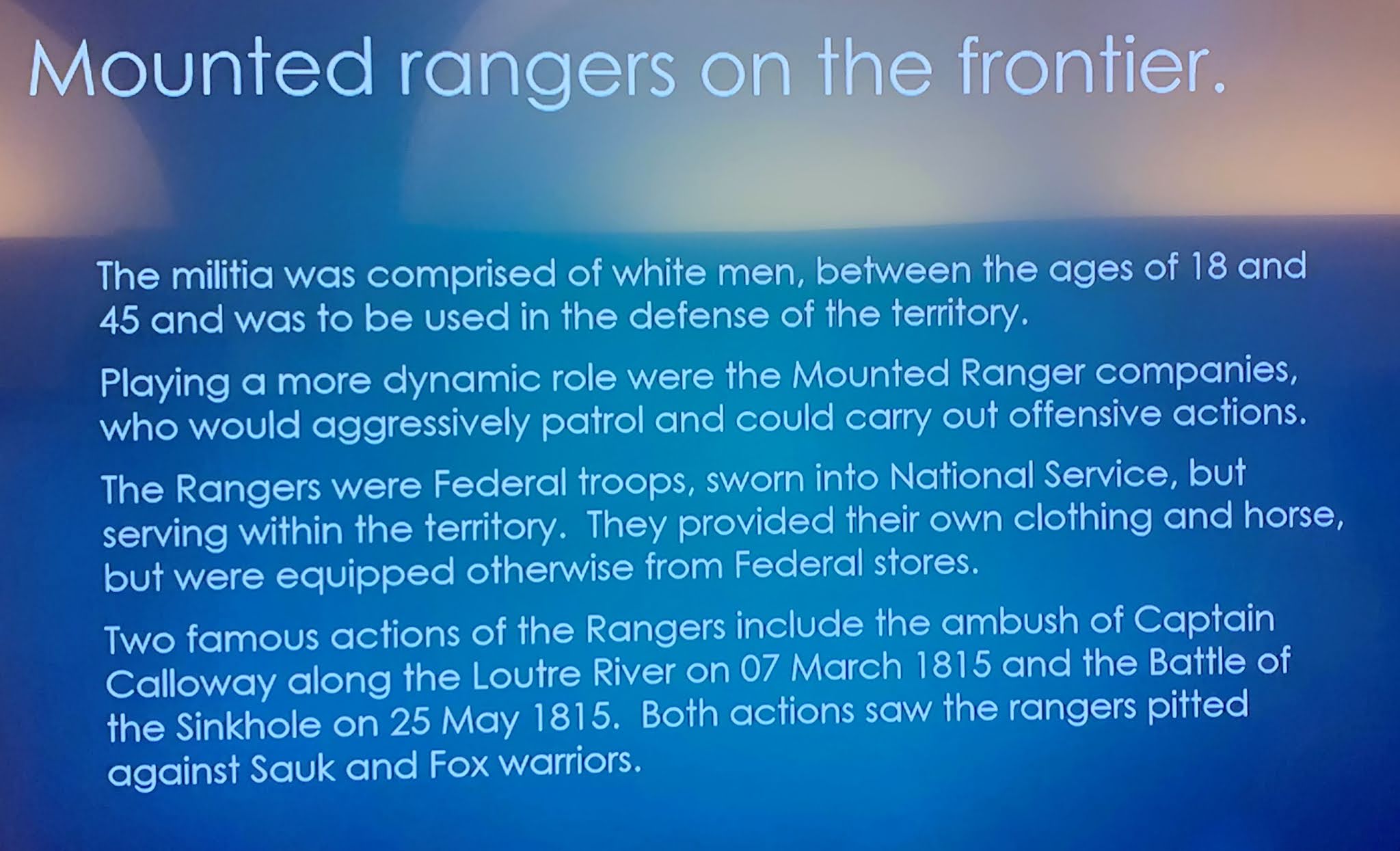
The mounted rangers date back to before Missouri was a state. 
The early soldier's life included blankets and clothing, canvas "half gaiters", forage cap, wooden bowl and eating spoon, tin cup, pocket knife, and a backpack. 
The uniform of the early soldier including during the War of 1812 battle in Missouri, included shako military hat with brim and plume, wool coatee with linen shirt and leather neck stock, linen fall front trousers, and shoes.  And a leather cartridge box and sling and the bayonet. 
A Missouri militiaman (1810-1840) in a straw "planters" hat, simple shirt and cravat, a gray woolen vest, a linen hunting smock, linen trousers, moccasins, a bag for carrying food and necessities, and a 1803 pattern rifle. 
First regiment of Missouri Mounted Volunteers (1836-1847) 
Union Infantryman (1861-1865) in a greatcoat, trousers, black leather waist belt, "Brogan" low quarter marching shoes, cartridge box and sling, cap box and bayonet, M1842 smoothbore musket. 
1St Missouri Volunteer Engineers in Union Army: Officer's leather haversack 
Missouri Volunteer Infantry, Confederate Army of Tennessee, wearing wide-brimmed slouch hat, common wool shell jacket, gray wool trousers, leather "Brogan" style shoes, linen haversack and canteen, infantry equipment, and musket. 
Soldier's Equipment during the Civil War era included two separate carriers to carry ammunition: the cartridge box on the right and the cap box, or pouch on the left below. 
Missouri in the Spanish-American War: 1889 pattern campaign hat, 1883 pattern blue flannel pull over shirt, 1894 pattern Mills belt, canteen, and a Colt double-action revolver. 
National Guard in early 1900's: Khaki Mills cartridge belt. 
National Guard on the Mexican Border, 1916-1917: campaign hat and shirt
Doughboy, 1917-1918, World War I
Missouri National Guard
The Viet Nam War, U.S. Marine Corps
Uniforms of Missouri sailor who had a navy and a Marine Corps uniform.
The museum has several posters on Missouri soldiers of note, including this one on Nathan Boone, son of Daniel. 
The grounds around the building and inside the stone wall have beautiful gardens cared for by volunteers. 

In the gardens is a marker donated in 2004 that designates the area as a Blue Star Memorial By-Way.  This designation, used in parks and historical grounds, commemorates soldiers who served overseas. 

Comments:  This museum was well-organized and in good condition.  

The volunteer was friendly and helpful.  


Thursday, May 13, 2021

Laborers House and Ordnance Stable

533 Grant 
Jefferson Barracks Park
St. Louis  63125

Admission is free.  Free parking in a parking lot. 

https://stlouiscountymo.gov/st-louis-county-departments/parks/places/jefferson-barracks-park/

Opened after 1951. 

The Laborers House was built of limestone in 1851 to house the civilian laborers who constructed the buildings in the Ordnance section of Jefferson Barracks. After the construction was completed it housed the ordnance keeper and his family. The summer kitchen that was with the house no longer exists. The house included a garden, most likely for growing herbs and flowers. Today there is a garden to the right of the house as well as behind it. Under those trees there is an area for weddings. 
The first floor has a large sitting room 


The second floor has three bedrooms. Plexiglass keeps visitors from entering these rooms. 
Second bedroom. 
A delightful piece of furniture in the this bedroom. It is a Victorian gentleman's shaving stand with adjustable mirror. 
The third bedroom is very small and currently only displays these two chests plus two chairs. 
The Ordnance Stable is across the road.  It also was built of limestone in 1851.  It housed two wagons and four horses. They were used to haul munitions to Jefferson Barracks from the St. Louis Arsenal where they were made. That the barn had two doors so that a wagon could get in is unique.  Because of the pandemic we were not allowed inside but were told that it houses wagons today. 
Today a park Visitors Center sits across from the stables. 
In the Visitors Center is a small gift shop. 
Comment: When we arrived we learned that the Laborer's House and Ordnance Stable were closed due to the pandemic.  A kind volunteer working in the Visitors Center let us into the house for a quick walk through.  It is a small house so not a lot to see but it makes sense to stop and see it when visiting the other Jefferson Barracks Park museums. 

We enjoyed the garden area around the house very much. We were greeted by a volunteer - a trail watcher - who told us about the various plants and the trails.  She was delightful and full of information.