Friday, May 14, 2021

Old Ordnance Room Museum

345 North Road
Jefferson Barracks Park
St. Louis   63125
314-615-5000

Free admission. Free parking in parking lot. 

https://stlouiscountymo.gov/st-louis-county-departments/parks/places/jefferson-barracks-park/

Opened in maybe 1950's. 
The Old Ordnance Room was built in 1851 and houses temporary exhibits on military themes. 
Like the Powder Museum, the building was built with thick limestone walls, wooden floors, and an arched ceiling for safety reasons in case there was an explosion. It also has glassed cases that cause reflection when photographing! 
This museum has rotating exhibits.  The current exhibit, Story of Missourians at War,  is on display for ten months. A walk through the museum gives you a chronological view of the role Missourians have played in the military for over 200 years.  

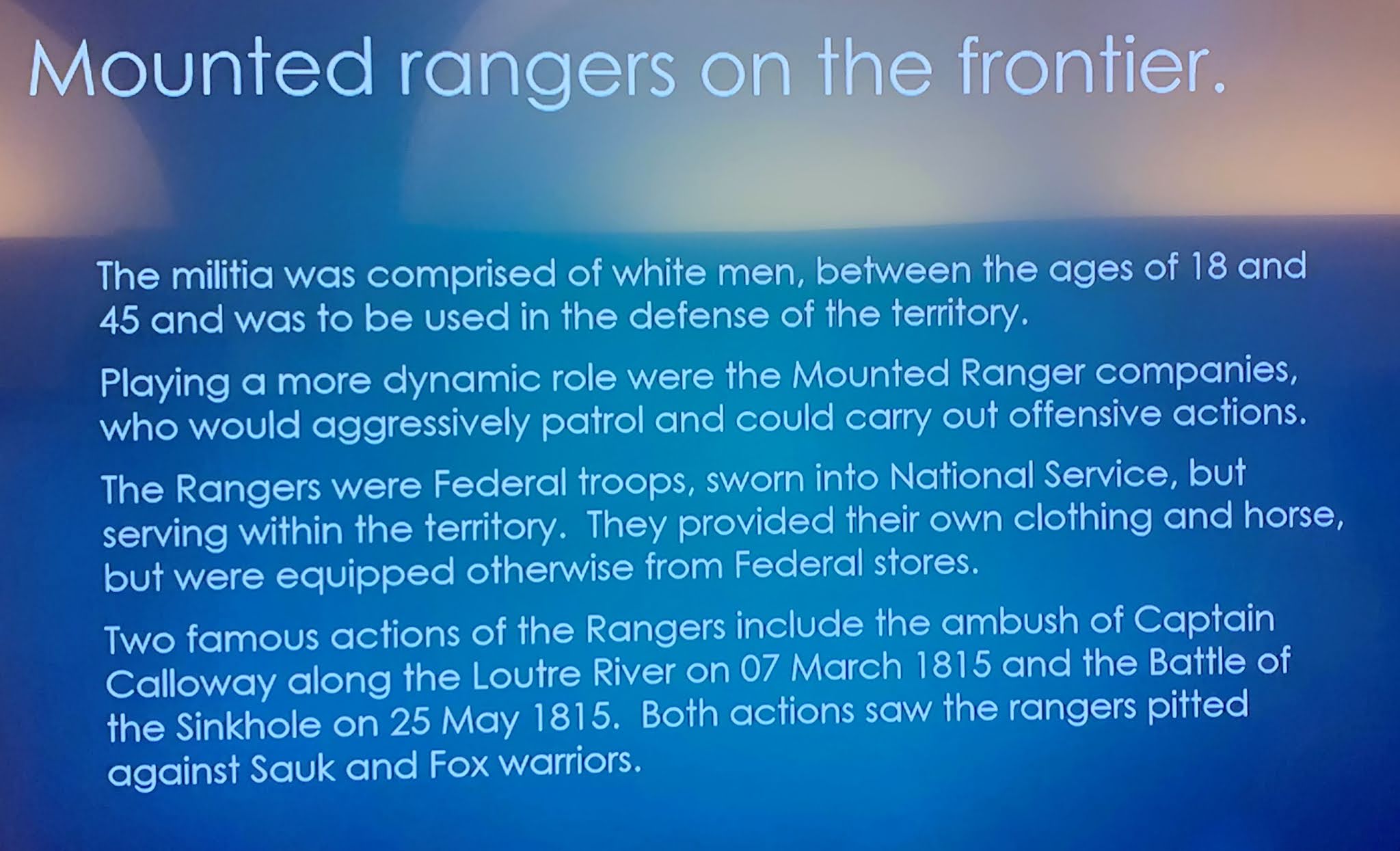
The mounted rangers date back to before Missouri was a state. 
The early soldier's life included blankets and clothing, canvas "half gaiters", forage cap, wooden bowl and eating spoon, tin cup, pocket knife, and a backpack. 
The uniform of the early soldier including during the War of 1812 battle in Missouri, included shako military hat with brim and plume, wool coatee with linen shirt and leather neck stock, linen fall front trousers, and shoes.  And a leather cartridge box and sling and the bayonet. 
A Missouri militiaman (1810-1840) in a straw "planters" hat, simple shirt and cravat, a gray woolen vest, a linen hunting smock, linen trousers, moccasins, a bag for carrying food and necessities, and a 1803 pattern rifle. 
First regiment of Missouri Mounted Volunteers (1836-1847) 
Union Infantryman (1861-1865) in a greatcoat, trousers, black leather waist belt, "Brogan" low quarter marching shoes, cartridge box and sling, cap box and bayonet, M1842 smoothbore musket. 
1St Missouri Volunteer Engineers in Union Army: Officer's leather haversack 
Missouri Volunteer Infantry, Confederate Army of Tennessee, wearing wide-brimmed slouch hat, common wool shell jacket, gray wool trousers, leather "Brogan" style shoes, linen haversack and canteen, infantry equipment, and musket. 
Soldier's Equipment during the Civil War era included two separate carriers to carry ammunition: the cartridge box on the right and the cap box, or pouch on the left below. 
Missouri in the Spanish-American War: 1889 pattern campaign hat, 1883 pattern blue flannel pull over shirt, 1894 pattern Mills belt, canteen, and a Colt double-action revolver. 
National Guard in early 1900's: Khaki Mills cartridge belt. 
National Guard on the Mexican Border, 1916-1917: campaign hat and shirt
Doughboy, 1917-1918, World War I
Missouri National Guard
The Viet Nam War, U.S. Marine Corps
Uniforms of Missouri sailor who had a navy and a Marine Corps uniform.
The museum has several posters on Missouri soldiers of note, including this one on Nathan Boone, son of Daniel. 
The grounds around the building and inside the stone wall have beautiful gardens cared for by volunteers. 

In the gardens is a marker donated in 2004 that designates the area as a Blue Star Memorial By-Way.  This designation, used in parks and historical grounds, commemorates soldiers who served overseas. 

Comments:  This museum was well-organized and in good condition.  

The volunteer was friendly and helpful.  


Thursday, May 13, 2021

Laborers House and Ordnance Stable

533 Grant 
Jefferson Barracks Park
St. Louis  63125

Admission is free.  Free parking in a parking lot. 

https://stlouiscountymo.gov/st-louis-county-departments/parks/places/jefferson-barracks-park/

Opened after 1951. 

The Laborers House was built of limestone in 1851 to house the civilian laborers who constructed the buildings in the Ordnance section of Jefferson Barracks. After the construction was completed it housed the ordnance keeper and his family. The summer kitchen that was with the house no longer exists. The house included a garden, most likely for growing herbs and flowers. Today there is a garden to the right of the house as well as behind it. Under those trees there is an area for weddings. 
The first floor has a large sitting room 


The second floor has three bedrooms. Plexiglass keeps visitors from entering these rooms. 
Second bedroom. 
A delightful piece of furniture in the this bedroom. It is a Victorian gentleman's shaving stand with adjustable mirror. 
The third bedroom is very small and currently only displays these two chests plus two chairs. 
The Ordnance Stable is across the road.  It also was built of limestone in 1851.  It housed two wagons and four horses. They were used to haul munitions to Jefferson Barracks from the St. Louis Arsenal where they were made. That the barn had two doors so that a wagon could get in is unique.  Because of the pandemic we were not allowed inside but were told that it houses wagons today. 
Today a park Visitors Center sits across from the stables. 
In the Visitors Center is a small gift shop. 
Comment: When we arrived we learned that the Laborer's House and Ordnance Stable were closed due to the pandemic.  A kind volunteer working in the Visitors Center let us into the house for a quick walk through.  It is a small house so not a lot to see but it makes sense to stop and see it when visiting the other Jefferson Barracks Park museums. 

We enjoyed the garden area around the house very much. We were greeted by a volunteer - a trail watcher - who told us about the various plants and the trails.  She was delightful and full of information.


Friday, March 6, 2020

George Vashon Museum

2223 St. Louis Avenue
St. Louis 63106
314-749-6322

Admission is $10.00

http://www.georgevashonmuseum.org/    

Founded in 2015

This museum is housed in an 1879 three-story mansion on "Millionaires Row" in St. Louis Place Neighborhood. Before the building was a museum it also was a funeral home and a church. 

This museum's founder, director, and curator is Calvin Riley, a retired educator. He has accumulated more than 4000 artifacts covering 250 years of regional African American History. A mission statement posted in the front hall spells out Riley’s goal: to preserve the history and achievements of St. Louis African-Americans and to recognize those who fought for civil rights and to change unjust laws. It also refers to the collection as the “The Spider Web,’’ because it has no ending and continues to grow.

Mr. Riley does not allow photographs to be taken inside the museum except for one room. This photograph from the front lobby gives you an idea of how many historical items are covering the walls of this old mansion. 

Among the many, many items in this collection are:

  • wooden chairs handmade by a slave
  • mannequins dressed in uniforms worn by Pullman porters and by nurses at Homer G. Phillips Hospital 
  • memorabilia from black social clubs of the 1950's
  • civil rights posters of the 1960's
  • original documents from the Dred Scott case
  • heirlooms owned by the family of pioneering attorney George Vashon
  • the reassembled laboratory of Dr. Lincoln Diuguid, African-American scientist
  • a sign that designated a "Colored Waiting Room" and came from St. Louis Union Station
  • photographs and documents of prominent African-American families from the early 1900's. 


The one room where a visitor is allowed to take a picture is 
the old funeral home chapel. The photograph gives you an accurate picture of how many items are crowded into this collection.  

Comments:  The only way to view this museum is by a guided tour by Mr. Riley. The tour lasts about one hour unless the group asks a lot of questions! 

Obviously this museum is packed full of artifacts.  That makes it difficult to see all the items as you walk through. If one were allowed to wander about I could see spending a few hours in there noticing each item. It is very impressive what this one man has collected.  

There were a number of very interesting items in this museum. 

This black history museum is less than two blocks from the Griot Museum of Black History, thus we visited them on the same day with lunch at Crown Candy Kitchen in between the two museums visits. 


Thursday, March 5, 2020

The Griot Museum of Black History

2505 St. Louis Avenue
St. Louis, Missouri 63106
314-241-7057

Admission is $7.50 (adults) and $3.75 (children); street parking is free.

https://www.thegriotmuseum.com/

Founded in 1997. 
The Griot Museum is housed in  the building that once housed the school of the Most Sacred Heart Catholic Church.
This St. Louis museum opened in 1997 as the Black World History Wax Museum. It was one of only two museums in the country to use life-size wax figures to interpret the contributions of African-Americans with local or regional connections.

The lifelike wax characters are still there, but in 2009, the organization changed the name to The Griot (pronounced Gree-Oh) because it better captured the mission and purpose of the museum.
That mission is: "Through compelling core exhibits, dynamic touring shows, educational and entertaining public programs, we create a community of lifelong learners who explore, experience and embrace the region's rich and enduring African-American heritage."
Photographs are only allowed to be taken in the lobby.  From the front door one can see all the rooms holding exhibits. To the left is a gift shop.  

Among the many exhibits are:
-a full-scale recreation of a section of a slave transport ship
-a powerful video about the experience aboard a slave ship
-a list of names and addresses of area slave traders in 1841
-examples of chains and shackles
-many period artifacts
-an actual slave cabin that was one of 16 slave cabins on the Wright Smith Tobacco Plantation in Montgomery County
figures of famous and important people of St. Louis black history in the areas of music, advocacy, agriculture, and service to the community including Josephine Baker, Dred and Harriet Scott, George Washington Carver, Miles Davis, Senator J.B. Banks, and York. 

When we were there the lower level had a special multimedia exhibit titled Black Women Speak. They offer several special exhibits each year. 

And here we are in the lobby with a wax figure.  
For lunch we stayed in the area and went .7 mile to Crown Candy Kitchen, one of St. Louis's most well-known eateries. This restaurant has been open since 1913. 
Their Heart-Stopping BLT has been designated an "Adam Richman's Best Sandwich in America" and we certainly ordered and enjoyed it!
They also have great chili!
Many people flock there for their ice cream. 
And of course, the candies which were their original offerings and are still popular today. 


Comments: This was an interesting museum about a subject which many of us do not know enough.  It is one of three museums in St. Louis dedicated to black history/culture/art. 

The museum is well-organized with a lot to see, read, and absorb.  One could spend up to two hours enjoying it all and learning much from it. It is a popular school field trip destination. 

Reservations are required.  Check for Groupons.  

Of course, lunch at Crown Candy Kitchen was wonderful.  It has a very casual atmosphere and excellent food. Plus you can't live in St. Louis and not go there at least once!